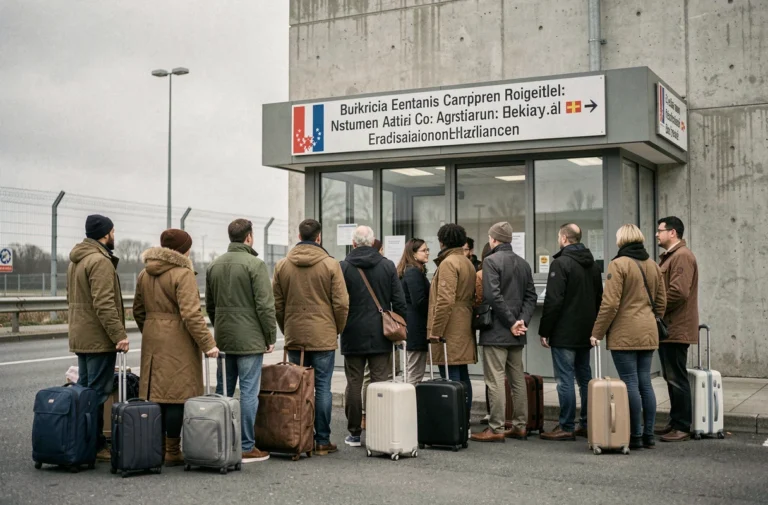
The average commute time for workers in Île-de-France is 32 minutes, and nearly one in three Parisian workers considers this commute detrimental to their quality of life. Working in Paris without sacrificing well-being starts with a clear understanding of what daily life truly imposes on the body and attention, well before any questions of productivity or personal coaching arise.
Commute to work in Paris: the lever that most well-being strategies ignore
We observe that the majority of advice on work-life balance treats the commute as a fixed data point. This is a mistake. Commute time is the primary source of nervous fatigue for Parisian workers, often more so than the workload itself in many cases.
Forty percent of workers in Île-de-France spend more than 30 minutes commuting one way. This time, rarely considered recovery, adds to the day without being counted as work or rest. It generates a diffuse fatigue that neither a workout nor a lunch break can compensate for.
Since 2025, public transport traffic in Île-de-France has returned to levels close to those before the health crisis, according to the CCI Paris Île-de-France. Remote work is no longer sufficient as an adjustment variable. We recommend negotiating not just a number of remote days, but specific days of presence based on peak traffic times. A Tuesday on-site is better than a Monday in terms of transport stress.
To follow the news on Emploi Web, this connection between mobility and work organization is one of the topics regularly documented by industry professionals.

Right to disconnect: what your company agreement should really provide
The right to disconnect has existed in the Labor Code since 2017. In practice, most charters merely remind that emails should not be sent after 8 PM. This is not an operational measure; it’s a display.
Recent recommendations for employers go further. They advocate three concrete axes:
- Define explicit availability time slots, integrated into messaging tools (automatic statuses, notification blocking)
- Train managers not to contact their teams outside these slots, including through informal channels like instant messaging
- Ensure that the assigned workload does not force employees to work into the evening, which makes any charter unenforceable
This third point is the most neglected. A disconnection charter without an audit of the actual workload is akin to prohibiting overtime while setting goals that make it inevitable. HR professionals who take the issue seriously incorporate quarterly monitoring of workload by team.
Specifically, what to check in your remote work agreement
A remote work agreement or charter should address several points that directly condition daily well-being: coverage of expenses, conditions for work-related accidents at home, and methods for monitoring working hours. A vague agreement on these topics exposes the employee to stressful gray areas.
We recommend reading the entirety of the applicable agreement in your company, not just the HR summary. Clauses on the right to refuse motivated by the employer and on the reversibility of remote work are the ones that truly protect your professional balance.
Health and performance in Paris: rethinking limits rather than productivity
Management literature is full of methods for “working better.” Pomodoro, deep work, time blocking. These techniques work on paper. They fail when the structural framework (transport, noisy open space, cascading meetings) leaves no exploitable time slot.
Setting clear limits on meetings produces more effect than any concentration technique. A professional who blocks two mornings a week without meetings recovers between four and six hours of deep work, without additional willpower effort.

Chronic stress and warning signs not to rationalize
Work-related stress in Paris often takes an insidious form. It is not the occasional peak load that wears you down; it is the lack of recovery between peaks. The signs to watch for are not spectacular: mild but persistent sleep disturbances, disproportionate irritability during commutes, difficulty concentrating by mid-morning.
These signs precede professional burnout by several months. Ignoring them by attributing them to the “Parisian rhythm” is exactly the mechanism that transforms manageable fatigue into a deteriorated health situation. A check-up with a health professional at work, before resorting to coaching or career change, remains the most reliable approach.
Parisian career and confidence in professional choices
Many Parisian employees remain in uncomfortable situations for fear of losing a network, salary, or status. This inertia has a concrete cost on health and personal life.
Staying in Paris is not a prerequisite for an ambitious career. The development of hybrid work, the decentralization of certain sectors, and the rise of regional hubs are changing the game. The pertinent question is no longer “how to hold on in Paris” but “is Paris still the right framework for my current professional project.”
For those who choose to stay, the challenge is not to multiply relaxation strategies. It is to build a work framework where limits are set in advance: optimized commute, verified remote work agreement, negotiated workload, respected disconnection times. Daily well-being is not decreed by morning rituals; it is built through structural decisions made once and applied sustainably.