18%. This is the growth rate of the global role-playing game market in 2023, according to ICV2. For the first time, this sector has surpassed traditional board games in some areas. And it’s not just a numbers game: hybrid formats are multiplying, gradually erasing the boundary between strict rules and narrative freedom. In some systems, it is no longer the roll of the dice that decides, but a collective decision on the narrative. This is bound to make purists grind their teeth, as they cling to a gaming orthodoxy where mechanics take precedence over story.
Why is role-playing experiencing a resurgence?
The role-playing game has never been more alive. Once niche, it is now entering households everywhere and attracting a wide variety of audiences. With the media spotlight on licenses like Dungeons & Dragons in series such as Stranger Things or The Big Bang Theory, curiosity has spread far beyond the circle of insiders. On Twitch or YouTube, streamed games transform the gaming table into a true stage, where spectators and players share the same emotions in real-time.
Let’s take a moment to look at who gathers around these tables: entire families, children, publishers, creators, as well as loyal groups of friends who come together to escape together. Conventions like Gen Con are sold out, multiplying discovery sessions and showcasing a plethora of universes that continuously renew the practice, beyond the traditional caped and sword-wielding hero.
Accessibility is rapidly improving, especially thanks to productions like Donjons & Chenapans or those from La Loutre Rôliste, which open doors for younger audiences. The enthusiasm passes from one generation to the next, often bringing together young and old around the same adventure.
The other driving force behind this evolution lies in the proliferation of online role-playing platforms. Initiatives are multiplying: scenarios available at the click of a button on DriveThruRPG, digital tools to facilitate remote play, and role-playing streaming that brings entire communities together around the same virtual table.
Mainstream media is now taking an interest, highlighting the inventiveness that characterizes the role-playing scene. In its precise and accessible reports, La Règle du Je deciphers the changes in the sector. And everywhere, discussions are heating up: debates around inclusivity, new audiences, the growing diversity of profiles, and the desire to invent universes that reflect everyone. Clearly, this movement is not just a passing trend. It reflects an energy that tirelessly redefines the codes of collective gaming.
Narration, the engine of emotions and collective immersion
It is impossible to separate role-playing from narration. In each game, the game master, or GM, sets the pace, adapts, and reacts to the surrounding enthusiasm. Players do much more than apply rules: every decision, every risk taken shapes the story that is unfolding. Chance may intervene at times, but expression, engagement, and collective choice carve the memory of sessions that leave a deep imprint.
The scenario is never fixed; the real story is woven together as a group. Unexpected detours, sudden rebounds, and the richness of the universes proposed, from medieval fantasy to worlds inspired by Nordic mythology or social themes, rely as much on the creativity of the participants as on the game modules. Antoine St. Epondyle has demonstrated this in his analyses: the variety of styles nourishes an inventiveness that far exceeds the confines of the rules. Dramatization takes shape through props, staging, voices, and sometimes drawings that enhance the feeling of immersion.
This spirit can be found beyond the gaming tables. Many enjoy the same narrative freedom in narrative board games, RPG video games, or those must-have choose-your-own-adventure books. Olivier Hamel highlights these works where the reader decides the fate of the main character. Jean-Christophe Pelletier, with Mon Samsara, embraces a game where mechanics and fiction go hand in hand. Mathilde Savoie, for her part, examines embodied narration through Half-Life, a subtle link between digital reality and tabletop sessions.
To better highlight the plurality of the game, these three axes are crucial:
- Narration: it sets the scene and weaves the collective story.
- Reconstruction: it gives body and atmosphere to each explored world.
- Dramatization: it brings tension, emotions, and conflicts to the heart of the adventure.
This mode of collective expression creates memories as intense as those of a good novel or a memorable film. The story is not lived alone; it is shared and built together, and this is where immersion truly springs forth.
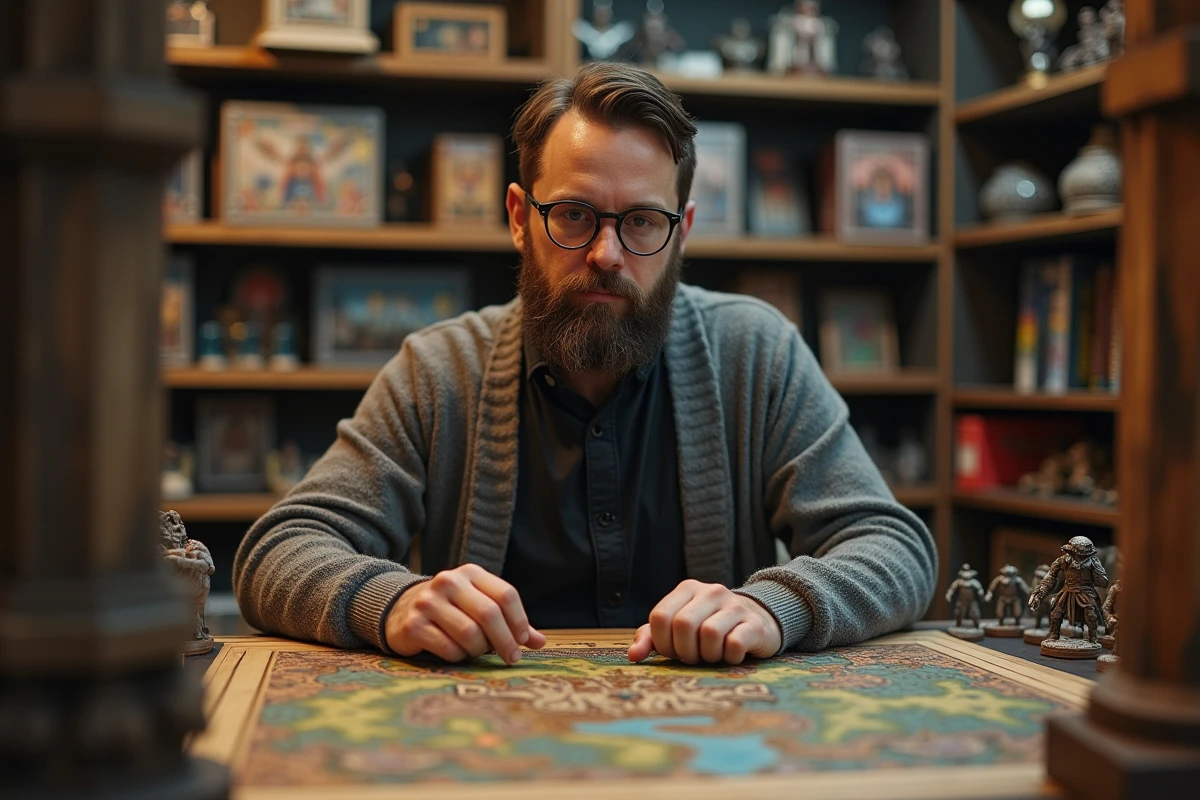
When storytelling becomes play: the impact of narration on our gaming experiences
In role-playing, storytelling and embodying intertwine. It is in this infusion of narrative into mechanics that the pleasure lies: everyone can act, choose, invent, and enrich the universe. The GM does not just drive the action; they provide a framework that the whole group will elevate in their own way, in a synergy made of listening, boldness, and creative rebound.
This boundary that fades between player, spectator, and storyteller today inspires a multitude of games. Many narrative board games or video games employ elements from role-playing to multiply forms of gaming experience. As for the choose-your-own-adventure books, they still invite the reader to advance as an actor, to take chances on unexpected paths.
Let’s highlight here the main dimensions of these experiences:
- Narration: it is the art of building new stories together, on the fly.
- Reconstruction: immersion in rich worlds, inhabited by characters who evolve and surprise.
- Dramatization: the opportunity to explore the full range of emotions, from hesitations to great victories.
Role-playing creativity abounds in improvisation, the invention of original stories, and the creation of unique heroes. Current communities focus on an inclusive dimension, integrating themes, profiles, and new ambitions from the outset. Andariel’s work illustrates this well, blending reflection on LGBTQ+ representation with narrative innovation.
Whether they arise around a table, behind a screen, or through the pages, these adventures await a new breath of collective imagination. How far will the role-playing game’s ability to reinvent the way we live and tell stories go? The game has only just begun.