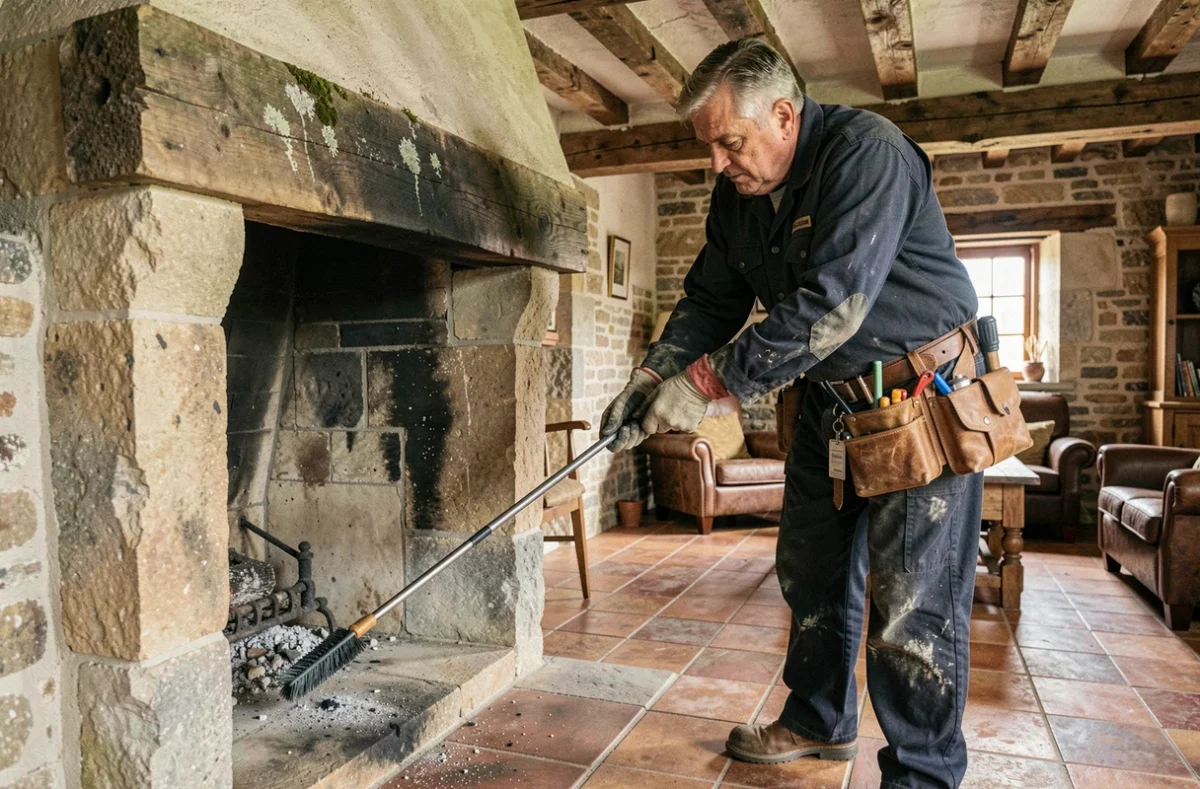
The sweeping of chimney and stove flues in the Ardennes follows a regulatory framework that has recently evolved at the national level. Since October 1, 2023, decree no. 2023-641 of July 20, 2023, redefines sweeping as a cleaning process through direct mechanical action on the inner wall of the flue. This national standard coexists with local rules, set by the departmental health regulations or municipal order, which may impose stricter frequencies.
2023 Decree and Departmental Regulation: Two Levels of Rules for Sweeping in the Ardennes
The most common confusion among Ardennes homeowners concerns the frequency applicable to their dwelling. The national decree sets a minimal baseline, but the local frequency may be more demanding. For wood, the common rule requires two sweeps per year, one of which must occur during the heating season. For oil or gas, an annual sweep is generally required.
The issue is that these frequencies are not uniform from one municipality to another. A homeowner in Charleville-Mézières and another in a neighboring village may be subject to different obligations. To clarify any doubts, the reliable approach is to consult the town hall or the prefecture of the Ardennes, which have the current departmental health regulations.
Homeowners wishing to anticipate their maintenance work can turn to Yvazur Construction services for tailored support based on the local context.
Sweeping Log and Mechanical Cleaning: What the Decree Really Accepts
Sweeping logs, sold in supermarkets and DIY stores, appeal due to their simplicity. They are placed in the fireplace, lit, and the chemical residues are supposed to detach soot and creosote from the flue. Many homeowners consider this operation a full-fledged sweep.
The 2023 decree clearly addresses this point. Article R. 1331-18 of the Public Health Code defines sweeping as a direct mechanical action on the flue wall. A chemical log does not meet this definition. It can serve as a maintenance supplement between two visits from the sweep, but it never replaces mechanical intervention.
In the event of a disaster, an insurer requesting the sweeping certificate will not consider a receipt for a log as proof of maintenance. This shortcut can be costly, both in terms of safety and compensation.
Sweeping Certificate and Home Insurance: The Document That Protects in Case of Disaster
The sweeping certificate is not just a simple service receipt. It is an administrative document that only a qualified professional can issue, in accordance with the decrees of April 2, 1998, and July 20, 2023. This document certifies that the flue has been cleaned mechanically, that its emptiness has been verified, and that the installation does not show any visible non-compliance.
What the Certificate Must Mention
- The identification of the intervening professional and their qualifications, which guarantee the validity of the document with the insurer
- The date of the intervention and the type of flue swept (wood, oil, gas), with mention of the connected appliance
- Any observations regarding the condition of the flue, such as the presence of creosote, cracks, or partial blockages
Archive each certificate for at least two years. In the event of a fire or carbon monoxide poisoning, the insurer may require proof of compliant maintenance. Without a certificate, coverage for the disaster may be reduced or denied, even if the home insurance policy is otherwise in order.
Creosote and Carbon Monoxide: The Concrete Risks of a Poorly Maintained Flue
Creosote is a black, hard, and flammable substance that forms inside flues when combustion is incomplete or when the vents remain closed during heating. The temperatures reached during a chimney fire caused by creosote can exceed critical thresholds for the structure of the flue and surrounding materials.
An Ardennes sweep quoted by the newspaper L’Ardennais emphasizes a simple action: keep the vents open when the chimney is heating to limit the formation of creosote. The use of damp wood or softwoods exacerbates the phenomenon. Dry wood, stored properly for a sufficient time, produces fewer deposits and reduces the risk of rapid soiling.
The other danger, less visible, is carbon monoxide poisoning. A flue blocked by a bird’s nest, a piece of masonry, or an excess of soot prevents the proper evacuation of combustion gases. Carbon monoxide is odorless and can be fatal within hours in an enclosed space. Mechanical sweeping precisely checks this emptiness of the flue.
Owner or Tenant in the Ardennes: Who Pays for the Flue Sweeping
The distribution of responsibilities between owner and tenant regularly generates disputes. Generally, the routine sweeping is the responsibility of the occupant of the dwelling, whether they are a tenant or an owner-occupier. This charge is included in the list of rental repairs.
The landlord retains responsibility for the compliance of the installation. If the flue has a structural defect (crack, lack of lining, connection defect), the restoration work falls to them. In co-ownership, the sweeping of collective flues is the responsibility of the property manager, while each occupant remains responsible for the individual part connected to their heating appliance.
A Point to Check Before the Heating Season
- Does the lease explicitly mention the obligation to sweep and the expected frequency in the Ardennes?
- Has the landlord provided information about the type of flue and any access constraints for the sweep?
- Has the certificate from the previous year been transmitted to the landlord or retained by the tenant for their insurer?
The ideal time to schedule the intervention is before autumn. Qualified sweeps in the Ardennes are often in demand as soon as the first cold weather hits, which extends waiting times. Anticipating the sweeping at the end of summer allows for starting the heating season with a verified flue and an up-to-date certificate.