The fracture of the sacrum remains underdiagnosed because its manifestations often resemble ordinary lower back pain or sacroiliac inflammation. Persistent pain in the lower back, worsened when sitting, may indicate a bone injury that standard X-rays do not always capture. Understanding the warning signs allows for quick direction towards the appropriate examination and avoids weeks of inadequate care.
Sacral Fracture and Imaging: Why the Diagnosis Lingers
The sacrum, this triangular bone wedged between the spine and the pelvis, bears a considerable part of the body’s weight. When it fractures, the pain often radiates to the buttocks, coccyx, or the back of the thighs. The problem is that these painful areas frequently lead the doctor to other hypotheses: sciatica, sacroiliitis, muscle strain.
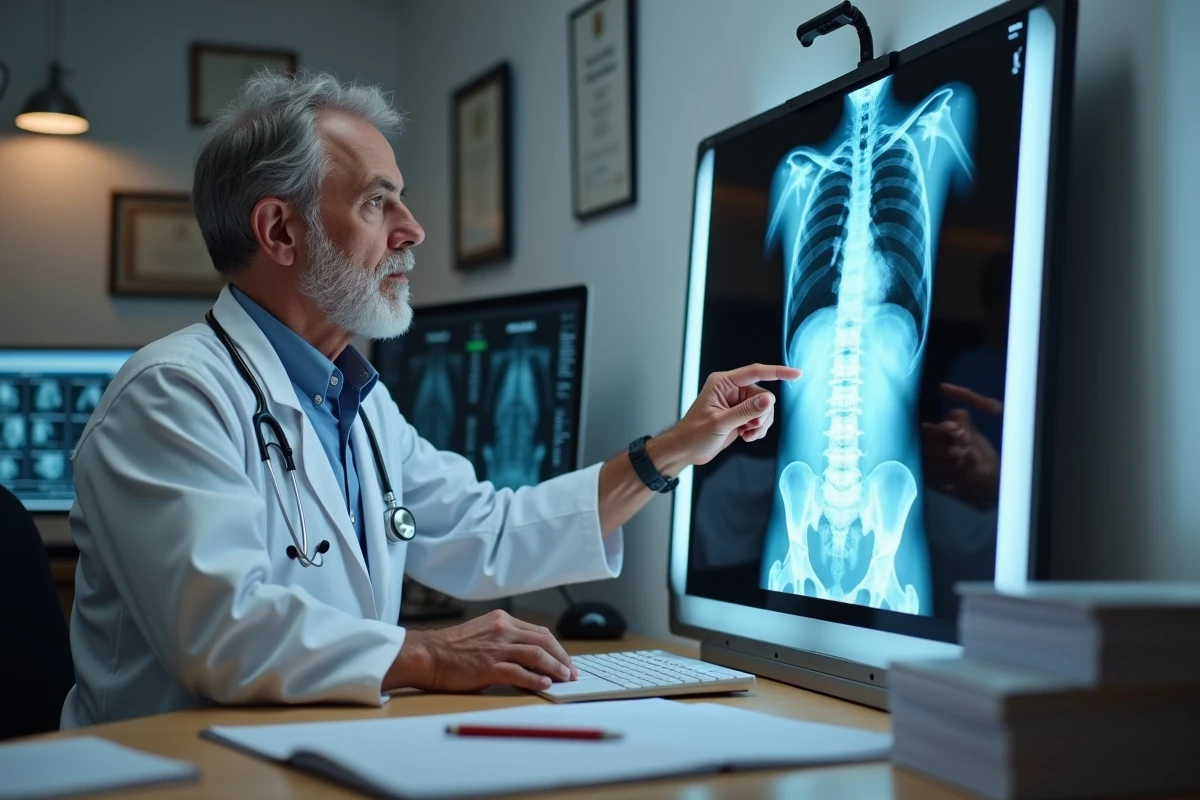
Standard X-rays miss many sacral fractures, particularly stress fractures (bone insufficiency). Only MRI or CT scans reliably confirm the diagnosis. MRI detects early bone edema, while CT scans specify the fracture line and its location according to the areas described by Denis’s classification.
To identify the symptoms of a sacral fracture, it is important to remember that the pain may remain moderate for several days before gradually intensifying, especially when walking or transitioning from sitting to standing.
Warning Signs of a Sacral Fracture: Distinguishing Bone Injury from Simple Lower Back Pain
Classic lower back pain usually eases with rest and anti-inflammatories. The sacral fracture, on the other hand, presents a different pain profile.
- Pain significantly increases with prolonged sitting and weight-bearing, while it decreases little or not at all with usual painkillers.
- Pain localized to direct pressure on the sacrum (and not on the paravertebral muscles) suggests a bone injury rather than a muscular one.
- Neurological symptoms may accompany the fracture: perineal numbness, difficulty controlling the bladder or bowel, weakness in one leg. These signs indicate compression of the sacral nerve roots and require urgent consultation.
- Walking becomes painful with a limping pattern, as the body instinctively tries to offload the affected side of the pelvis.
The onset of sphincter dysfunction is an emergency signal. Compression of the sacral canal (zone III of Denis’s classification) can cause cauda equina syndrome, which requires rapid hospital management.
At-Risk Populations and Mechanisms of Sacral Fracture
Two distinct patient profiles emerge. The first involves high-energy trauma: road accidents, falls from height. The pelvis absorbs a violent impact, and the sacrum often fractures in association with other pelvic fractures. The diagnosis is then made in a hospital setting, with a complete imaging assessment.
The second profile, more insidious, includes stress fractures. These occur in individuals with decreased bone density, typically after menopause or in the context of advanced osteoporosis. A simple misstep, prolonged standing, or gardening effort can be enough to cause the fracture. Pain develops gradually over several days, delaying consultation.
Long-distance runners and military personnel in intensive training constitute a third group affected by sacral stress fractures. Repeated mechanical overload eventually exceeds the bone remodeling capacity.

Recovery After a Sacral Fracture: Rest, Rehabilitation, and Realistic Timelines
Treatment depends on the fractured area and the stability of the injury. The majority of sacral fractures require conservative treatment: relative rest, appropriate pain relief, and limitation of weight-bearing during the first weeks.
Bone Consolidation Phase
Consolidation of the sacrum generally takes between eight and twelve weeks for stable fractures. During this period, walking remains possible but should be measured. The doctor adjusts the allowed load based on clinical evolution and, if necessary, imaging control.
A work stoppage is often necessary, with the duration varying according to the type of job held. Sedentary work can be resumed earlier than a physical job, provided that the sitting position is adapted (pressure-relief cushion, regular breaks).
Rehabilitation and Return to Activity
Rehabilitation begins as soon as pain allows. It aims to restore pelvic mobility, strengthen stabilizing muscles (pelvic floor, transverse, glutes), and correct postural compensations established during the rest phase.
- Pool exercises (hydrotherapy) allow for early muscle work without weight stress on the sacrum.
- Progressive strengthening of the trunk and lower limbs follows a protocol adapted by the physiotherapist, with an increase in load over several weeks.
- Returning to running or impact sports is only considered after clinical and sometimes radiological confirmation of consolidation.
Chronic pain remains a possible complication, particularly for fractures in zone III or spinopelvic dissociations. In these cases, management often includes follow-up at a pain center and prolonged rehabilitation support.
When Surgery Comes into Play
Unstable sacral fractures or those compressing nerve structures require surgical intervention. Fixation with percutaneous iliac screws applies to stable but poorly tolerated fractures. For more severe injuries, lumbar-pelvic fixation or surgical decompression of the sacral canal may be indicated.
Sacroplasty, a minimally invasive technique involving the injection of bone cement into the fractured area, represents an option for insufficiency fractures in elderly patients who do not respond to conservative treatment.
Complete recovery after surgery requires rigorous follow-up. Field reports vary on this point: some patients regain satisfactory mobility within a few months, while others retain residual pain beyond a year, especially when nerve roots have been affected. Regular follow-up with the doctor and physiotherapist remains the best guarantee to adapt the protocol to the actual evolution of each situation.