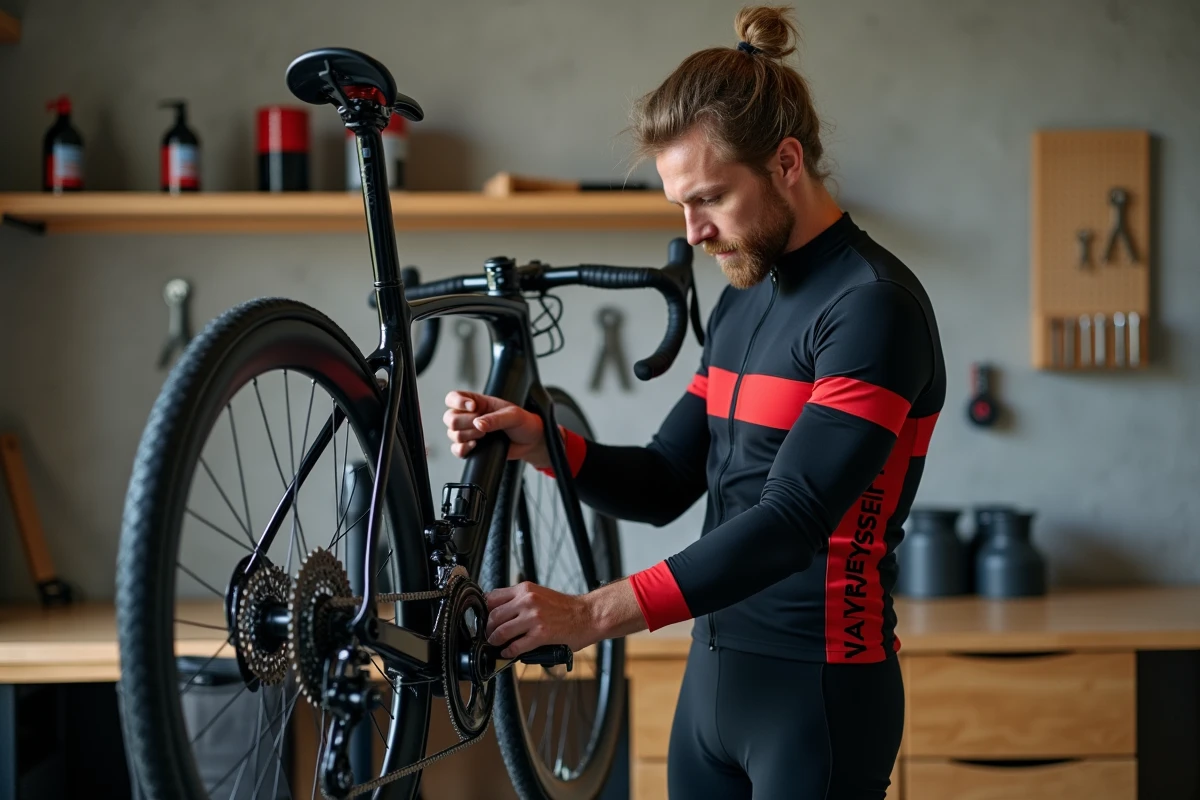
The RCR Pro Van Rysel is built on an aero-light balance that few frames at this price level offer. Getting the best out of this platform requires adjusting specific parameters, often overlooked by traditional assembly guides: spoke tension, differentiated pressure, fine-tuning of the integrated cockpit, and utilizing the INPEAK power sensor included as standard.
Integrated Cockpit of the RCR Pro: Torque Settings and Aero Positioning
The combo handlebar of the RCR Pro comes unlocked. Its reassembly affects both the rigidity of the steering and the aerodynamic profile of the cockpit. We recommend strictly adhering to the torque settings indicated on the handlebar itself, without rounding up to the nearest Nm: on a monocoque carbon cockpit, excess torque creates invisible micro-cracks that degrade rigidity within a few months.
The angle of the handlebar deserves special attention. Tilting the drops down by two to three degrees from the factory neutral position lowers the center of gravity of the hands and reduces the frontal area without changing the stack height. This adjustment transforms the acceleration into a dance and stabilizes the bike beyond 50 km/h.
The dedicated computer mount, compatible with Garmin, Wahoo, and Bryton, extends the line of the handlebar. Mounting it slightly offset downwards (lower rail position) avoids disturbing the airflow above the top tube. If you use lighting or an action camera on the second attachment point, opt for a model whose profile does not exceed the width of the handlebar.
For those looking to optimize their RCR Pro Van Rysel beyond the cockpit, the logical next step concerns the wheels and pressure management.
Tire Pressure and Swiss Side Wheels: The Most Underutilized Performance Lever

The Swiss Side carbon wheels supplied with the RCR Pro are among the elements that justify the bike’s pricing. Their aerodynamic profile works within a specific wind range, but it is the tire pressure that determines the quality of ground contact and, by extension, actual speed.
Too high a pressure loses more watts than it saves. On rough roads or in wet conditions, lowering the pressure by about half a bar from the usual value improves traction and reduces vibrations transmitted to the frame. The comfort gain directly translates to better muscle endurance on long rides.
We observe that most cyclists inflate the front and rear tires equally. On the RCR Pro, the weight distribution favors the rear wheel. Adopting a slightly lower pressure in the front (about half a bar less than in the rear) improves cornering grip and shock absorption without penalizing overall rolling resistance.
- Adjust the pressure according to the cyclist’s weight and weather conditions before each ride, not once a week
- Check spoke tension every few hundred kilometers: high-profile carbon rims amplify tension imbalances
- Replace brake pads (if rim model) or bleed the hydraulic system according to Decathlon’s guidelines, without waiting for a noticeable loss of braking power
INPEAK Power Sensor: Calibration and Training Strategy
The RCR Pro comes standard with an INPEAK power sensor, a piece of equipment that costs several hundred euros as an option with competitors. This sensor changes the way the bike is utilized, provided it is calibrated correctly and used as a guiding tool, not just a display gadget.
Zero offset calibration must be done with the crankset stationary, cranks horizontal, before each ride. Ignoring this step introduces a drift that skews power data by several watts, enough to invalidate a structured training plan.
Utilizing real-time power allows for smoother effort on climbs rather than relying on heart rate, which always lags a few seconds behind actual effort. On long ascents, aiming for a constant power slightly below the functional threshold preserves reserves for the finish. On flat terrain, coupling the power data with the displayed speed allows for real-time evaluation of the aerodynamic cost of a given position.

Frame Rigidity and Layup: What Technical Finishing Changes
Van Rysel has introduced a technical frame finish that reduces paint weight for the RCR range intended for the Decathlon CMA CGM team, improving the weight/power ratio. This evolution, stemming from WorldTour requirements, does not appear in consumer tests but directly influences the frame’s responsiveness.
Reducing paint weight is not cosmetic. Every gram saved on the periphery of the tube acts as a reduction of unsprung mass: the frame’s response to changes in pace becomes more immediate. For the cyclist seeking performance in competition or on demanding rides, this finish is especially felt in acceleration and short sprints.
The integration of wireless SRAM groups on setups intended for the pro team opens a path for RCR Pro retail owners. Switching from a wired Shimano group to a wireless setup reduces cable friction within the frame and simplifies maintenance of the integrated cockpit. The gain in shifting responsiveness is noticeable, especially under load while climbing.
- Clean the frame with a non-abrasive product to preserve the technical finish and avoid adding weight from wax or polish
- Inspect internal wiring inserts at each service: a cable rubbing against the carbon wall generates noise and wears the layup
- Monitor clamping areas (seat post, wheel axle) where excessive torque marks the carbon and weakens the structure in the long term
The RCR Pro has already been spotted in an even more aerodynamic form at the Critérium du Dauphiné, with optimized profile tubes. Paul Seixas has also engaged a new RCR platform in competition at the Tour Auvergne-Rhône-Alpes before any official announcement. These signals confirm that the current base of the RCR Pro remains a solid starting point, and that every adjustment made today prepares for the transition to the next generation of the chassis.